Those with experience in manufacturing understand the bottlenecking that can occur during the finishing stage. The process of painting parts and components seems to crimp workflows and create delays that throws a wrench into your production schedule. Greater efficiency is crucial for achieving a fast and agile operation and finishing without compromising quality. IntelliFinishing’s advanced technology can help optimize the way you finish, providing consistent, exceptional quality so that your business can remain competitive.

Do More with Smart Technology

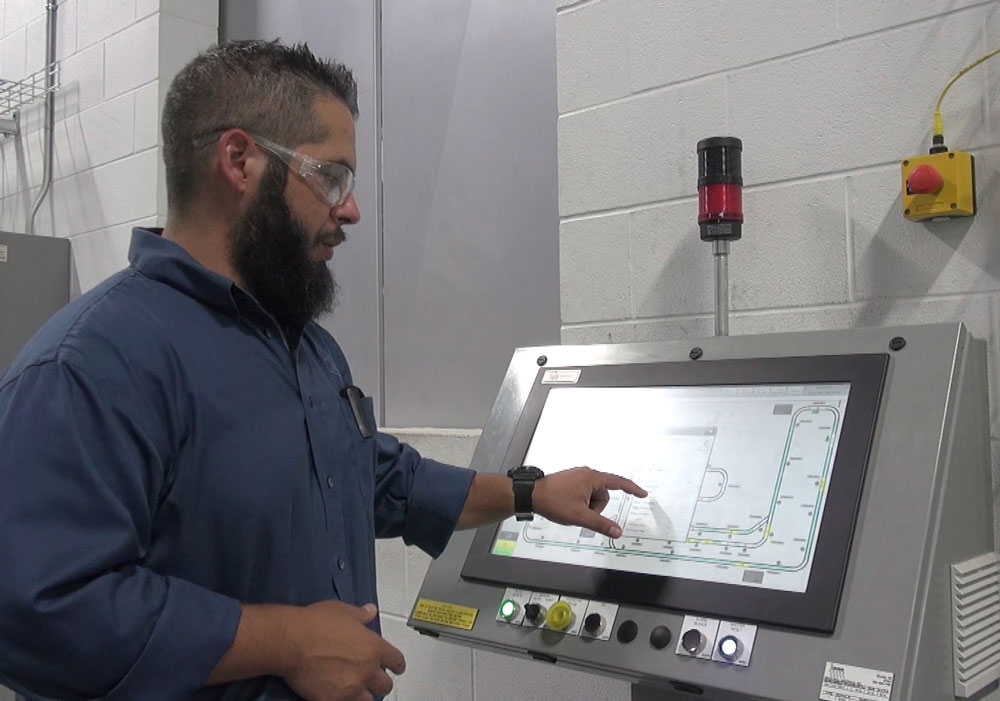
Old paint systems are out; new smart controls are in! As the name suggests, smart controls are advanced, digital tools that allow users to monitor and track parts, as well as provide insights to identify problem areas within a finishing process. Technology can pinpoint each part as it moves along the conveyor, as well as logging its weight, description, current process, previous process and the specified finish color.

Powerful Data For Maximum Efficiency

Smart systems provide a treasure trove of useful analytics. You can utilize this valuable data to identify bottlenecks and optimize your process. An intelligent system can also generate production reports that you can review, print, share, and evaluate. It logs historical production and process data so management can use the resulting reports to compare shifts, schedules, processes and the work of employees.

Recipes Made Easy

Applying a finish is much like baking a cake or cookies. It starts with having a desired recipe for the part from pre-finish steps, through paint, and ultimately to post finish steps such as cure, cool down and unloading. However, not every part finished should have the exact same recipe for optimal finishing. With a flexible automated finishing system, formulating, changing and applying recipes is as easy as a few keystrokes when using smart HMI controls – making it far more efficient than traditional paint and powder coating systems that rely on monorail conveyors or even power and free conveyors. An operator can input and review recipes on an intuitive display screen, and ascertain information such as Process Times, Production Rates, Order Status, Specific Parts per Carrier, Average Parts per Carrier, Load/Unload Efficiency, Blast Timing and Pressures, Wash Stage-Trends (temperature, pressure, titrations, duration and processes applied), Dry Oven Trends, Prime & Top Coat Trends and Cure Oven Trends. The system helps to identify errors before problems arise. For example, if a stage in your production list fails to meet the parameters of the recipe entered, smart controls flag it so you can remedy the issue before a finish has been applied. 

An Optimized Finishing Process

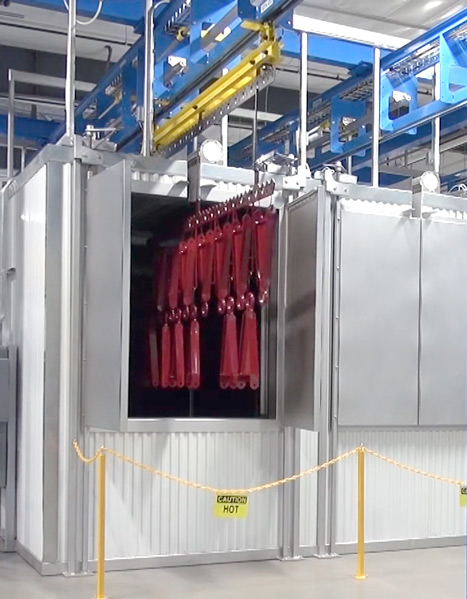
Smart controls make finishing fast by allowing multiple parts to be painted on a single system. Users can key in recipes that can be specific down to the part, and the system allows tracking of individual components. With IntelliFinishing, not only will your operation enjoy a fast and optimized process, but the system also ensures quality by reviewing connected environmental conditions, particularly helpful for CARC processes, or integration with other ERP or database driven systems.

Historically the finishing process has sometimes been a problem area in a manufacturer’s workflow, but not anymore. Through the integration of smart controls, IntelliFinishing stands out from competing systems, offering a faster way to convey parts through paint stations, maintaining exceptional quality and accumulating data to make your operation the pinnacle of efficiency. To see our smart controls in action, click here!

Have you discovered that most traditional paint finishing systems aren’t meeting the unique needs of your company? IntelliFinishing has flexible solutions that are anything but conventional, and we offer features that the traditional systems can’t compete with.

Unchained Technology

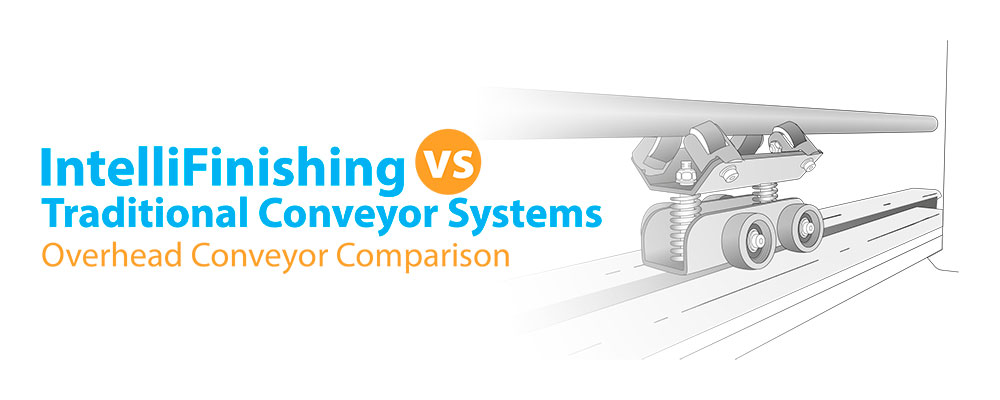
Unlike the chain-driven components of power & free and monorail finishing systems, our spinning tube, friction-driven conveyor technology allows parts to move both forward and backward within the system––maximizing efficiency and minimizing floor space. This feature eliminates falling debris from a dirty chain, and thus avoids contamination of parts. The control system allows you to input unique recipes for each part family and reduce chemical waste and energy usage by turning off the modules and conveyor when they are not in use. Not to mention, complete system setup results in up to a 30% smaller footprint. Read more

Choosing an automated finishing system that best suits a facility’s specific painting needs can be challenging. However, IntelliFinishing has created a logic-based flowchart that uses easy-to-answer questions to help determine whether a simple monorail system, a power & free system (P&F), or a friction tube conveyor system (such as is offered by IntelliFinishing) aligns with an operation’s respective part types and paint processes.

When Simple Questions Provide Quick Decision-Making

With simple questions such as “Do you need to powder-coat parts, liquid paint parts, or both?”, and “Will your finished parts be relatively inexpensive, or do you want to spend as little as possible on a system?”, stakeholders can use IntelliFinishing’s flowchart as a decision-making tool that rapidly assesses their actual requirements to ascertain which type of finishing system pairs to their business’ needs. Read more

Kevin Howe, IntelliFinishing Product Manager, discusses the evolution of conveyor systems in the finishing industry. Read more


The old saying is true: You don’t know what you don’t know. For example, when purchasing a powder coating finishing system, if you don’t have all the facts it’s difficult to know what will work best for your unique business. That’s why IntelliFinishing, a complete finishing system provider offering ultimate flexibility, encourages its customers and those seeking automated finishing system to educate themselves on “what they don’t know.” This ensures you will make the best choice based on your business’ specific needs. In addition, joining organizations such as the Chemical Coaters Association International (CCAI) and Powder Coating Institute (PCI) provides the opportunity to learn about current and future finishing technology options, investigate equipment and service providers, and connect with peers to make sure you choose the best system for your operation. IntelliFinishing is a proud member of both of these great organizations. Let’s take a look. Read more

Finishing a surface adds value to products, enhancing both aesthetic appearance and component performance. But perhaps the most vital role of a finish is protection. The IEEE estimates that corrosion or structural breakage costs over $100 billion annually in product loss. A great finish provides an effective shield that combats the effects of deterioration-causing elements and damage. Read more

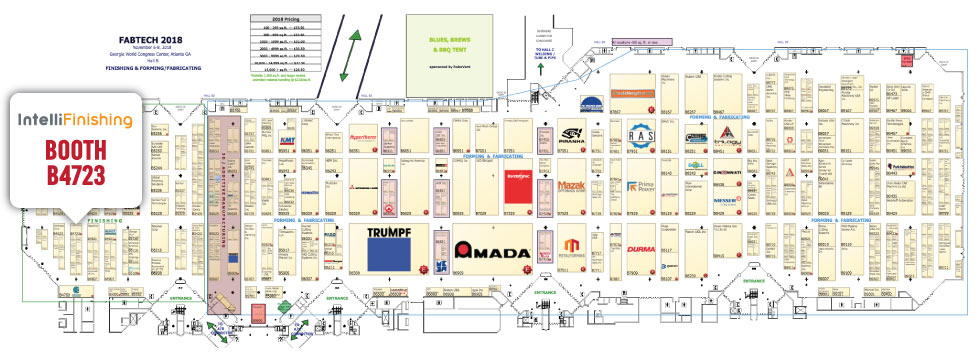
FABTECH 2018 is right around the corner, and here at IntelliFinishing, we’re rehearsing a fantastic educational presentation! This year’s annual event celebrating the best in metal manufacturing is being hosted in Atlanta at the Georgia World Congress Center from November 6-8. Come and join more than 35,000 attendees for demonstrations by over 1,500 exhibiting companies, as well as informative workshops and presentations by thought-leaders on the latest trends and technology in the metal forming, fabricating, welding and finishing industries. You’ll definitely want to mark your calendar for a certain can’t miss discussion – C60 Automation – Is It for Everyone? on Wednesday, November 07, 1:30 PM – 3:30 PM, Room: B301. IntelliFinishing’s John Claman will lead off that session with his presentation on the Levels of Automation for Finishing Systems. Read more

For Caterpillar, the painting process traditionally created a bottleneck in their manufacturing process.  The variety and complexity of parts resulted in a wide range of finishing times that often slowed the entire production operation.

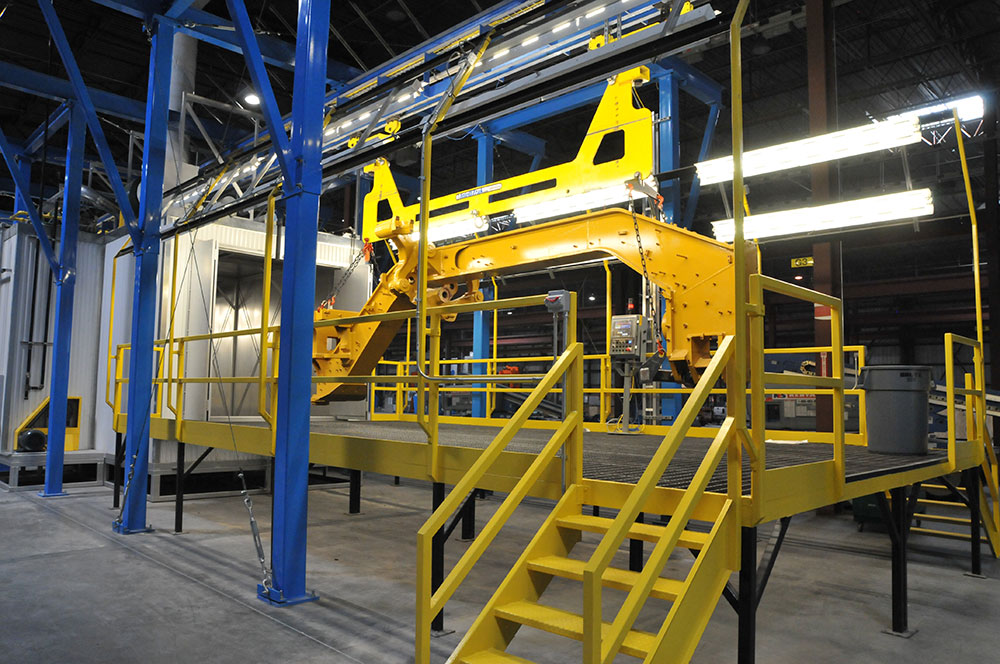
About a decade ago, Caterpillar, looking to streamline this process, partnered with IntelliFinishing to develop and install lean finishing systems at seven manufacturing locations.  After nearly 10 years of operation, these efficient finishing systems are still delivering consistent and reliable performance, offering unparalleled flexibility to adjust finishing needs as they evolve. Read more

John Claman, IntelliFinishing & Kasa Controls Sales & Marketing Supervisor, discusses how IntelliFinishing provides flexible finishing solutions for powder coating and liquid paint.

Automation is an integral part of any manufacturing facility, making operations smoother and more cost effective. Increasingly, next-generation finishing systems are expanding automation capabilities, allowing for efficiency, flexibility, and scalability in correlation to an operation’s requirements. In fact, there are up to five levels of automation that you can achieve in terms of historical, existing, and future systems, including the Internet of Things (IoT) devices.

Let’s look at each level of automation to dive deeper into these processes. 

Levels of Automation for Finishing System

The levels of automation follow a chronological path; however, older technologies are still important today. Here are the different levels:

0-Hardwired Control

At this level, there is really very little automation, requiring almost complete operator intervention. Many conveyorized finishing systems still operate at a hardwired level of control. These include some new systems, but also, many existing systems that may be years if not decades old. These systems tend to lack flexibility and the ability to adapt, but are very robust and durable.

1-Mimic Panel

At this level, there is limited automation, and most electricians would be able to troubleshoot an issue should one occur. This level still requires a lot of operator intervention and can be costly to design and build. In fact, the use of mimic panels for automated finishing systems is quite uncommon.

2-Touch Screen Hardware Terminal

At level two, you will be able to automate most processes or simple systems using basic PLC (Programmable Logic Controllers) control systems. Replacing relays with PLCs adds flexibility (easier to make changes) and enhanced reliability in a smaller package, providing increased functionality while reducing the overall cost to design and build.

With simplified computer screen operator features, electricians trained on the equipment would be able to troubleshoot many issues. However, specialized controls programmers/engineers may be required to set up or change the PLC programming. Typically associated with the control of process items like washes and ovens, this level is very prevalent among most existing finishing systems. Some Power and Free conveyor systems are also controlled by the PLC and HMI set up.

3-PC-Based (HMIs)

With PC-level computing and operation functionality, automation opportunity increases here, including data collection and storage capabilities. Further, at this level, the integration of smart automation is possible for tasks like recipe control. There is an added expense in maintaining automation at this level due to more sophisticated control programming. However, efficiencies are gained due to simpler operation, more flexible part processing, increased reporting, and a significant reduction in manual operation.

4-Database/Web-Based

While not common in most finishing systems as of yet, many companies are moving to level 4 automation for other areas of their industrial facility—especially larger OEMs. At this level, companies are leveraging the newest software capabilities to connect the plant floor to the boardroom suite. This level starts to unite traditional Operational Technology (OT) with Informational Technology (IT). Often, companies initiate level 4 by standardizing system and locational OT processes around a unifying industrial software solution. There are fewer software programs to maintain, but software modification or unforeseen problems will necessitate the services of expert technicians and programmers.

These systems are designed to collect and access data as well as to be deployed over multiple processes or facilities for consistency, quality control, and benchmarking/data analysis. The base capabilities of some software platforms at this level can include reporting and system operation to unlimited operator terminals, the ability to handle unlimited data points (tags), and connection to an unlimited number of other software databases such as ERPs, MES, etc.

5-Fully Integrated Robotic Systems:

This level offers robotic automation for processes and conveyance.

Robotic use implies the minimization of operator engagement. Robots are often deployed in the paint booth itself for both liquid and powder systems, but they are also used to load parts on to or off of finishing systems. Typically, articulating arm robots are used for these tasks. However, reciprocating spray systems in booths, washes that adjust to part dimensions, blow off tunnels that focus in tightly on parts based on their geometry, as well as other aspects of automated systems are also forms of robotics.

To make changes or troubleshoot robots, a programmer or someone trained in the robot’s specific controlling software is usually necessary. Robots can also be controlled in conjunction with the entire finish system HMI control as part of the recipe control. The system can also collect data on the robot’s performance. And with software control, the robot operation can be replicated across multiple applications, processes or locations. 

Considerations When Choosing Your Level of Automation

To discern what level of automation is right for your plant, there are several considerations to ponder. What is most important in your finishing processes?

  • Better utilization of employees?
  • Improved efficiency of people and equipment?
  • Faster turn on finishing products?
  • Safety?
  • Energy savings?
  • Enhanced finish management and quality control?
  • Improved system flexibility to coat a wider assortment of different parts and materials?
  • Increased overall visibility of operations for managers and executives?
  • Preventive maintenance at the right time to significantly reduce unplanned downtime?

You should also look at historical operational data. Decisions are often driven by reliability, the integration of safety features, product rates, capacity expansiveness, the level of operator intervention that will work best, remote connection for data and support, as well as the possible integration of third-party equipment.

The level of automation must also align with the variety of pieces being finished. With increased part complexity comes the need for a highly flexible finishing system. In these situations, higher levels of automation and versatile recipe control make the most sense.

Cost is also an important consideration. While automation initially represents significant outlay, it offers rapid ROI based on lower operational expenses and improved quality. However, there are some “hidden costs” related to automation. These include the need for programming and employees skilled in the respective software, downtime due to normal computer vulnerabilities, increased demand for back-up of system data and redundancy, and operator training. Ultimately, having a programmer to keep the software running smoothly should help to save on troubleshooting or expensive outsourced programmers. Conversely, with higher levels of automation software, predictive maintenance is possible so there should be less overall unplanned system downtime. 

The Future of Automation of Finishing Systems

With many impactful technologies on the horizon, the future of finishing systems automation will, of course, continue to change. These innovations include:

  • Smart sensors and devices that make decisions independent of the PLC
  • Artificial intelligence (AI) that will enable machine learning and decision making
  • Augmented reality (AR) that will empower smartphones and other devices to produce 3-D or holographic images for training and instruction
  • Emulation software to mimic operations in near real-world scenarios, much like video games
  • And more!

These modern advancements will generate even more data to be stored and shared, allowing operators to make better decisions that improve the efficiency and effectiveness of finishing systems. To some extent, it will also require even greater abilities for data managers to consolidate data, report metrics in impactful ways, and employ even more sophisticated system analysis and diagnostics. 

Elevate Your Finishing System

IntelliFinishing is a complete finishing systems provider that combines smart technology with our revolutionary modular conveyor for the most flexible finishing system available. This fusion of advanced engineering and progressive technology allows individual sections of the conveyor to move independently in both speed and direction, as well as to control each process via one unifying operational software that allows for per carrier recipe flexibility. A variety of manufacturers use our systems for a best-in-class finishing process. Experience it today by watching the system in action.