So you’re in the market for a new automated finishing system that’ll allow you to bring finishing in-house in order to optimize the speed of your production process and save money. Or, you need a new automated finishing system because your existing system just can’t keep up with demand, is prone to breakdowns, or can’t accommodate your new products or desired processes.
After some research, you’ve narrowed down your selection to a traditional overhead chain-based system such as a monorail or a power & free (P&F) system, and an IntelliFinishing system. While upfront costs will factor into your decision-making, you should also remember to estimate the operational costs of running the system, as the differences can significantly impact your bottom line. Here are five ways your IntelliFinishing system can save you money on operational expenses compared to competing traditional chain-based systems, lowering your total cost of ownership.
No chain system absorbing BTUs: The problem with heavy duty chain-based conveyors is that the chain system itself can absorb 10 to 23% of the BTUs emitted by dry off and cure ovens. This requires the system to burn more fuel to complete the finishing process leading to greatly increased natural gas and utilities costs. But your IntelliFinishing system, by using a conveyance that is mounted above and outside each oven with only the parts and hangers running through the oven has no chain to absorb and to drag heat out of the oven. The result is a more energy efficient system that doesn’t waste thousands per month in BTUs. Plus, the chain heat is constantly being distributed throughout your facility. This might be viewed as a plus in mid-winter, but it can be quite unpleasant during more moderate weather months – often making working on or near the finishing system one of the “hottest” jobs at the factory – and we don’t mean that in a good way! By comparison, working on or near the ovens on your IntelliFinishing system will seem quite pleasant. This is also due to the highly efficient construction of the ovens, but ultimately your IntelliFinishing system will decrease your system and building cooling costs significantly. It might even make working near or on the finishing system…”cool”, too.
Doors help lock in the savings: Anyone paying a home utility bill understands the agony of seeing an open front door while the heat is on during the winter or the A/C is on in the summer: it’s throwing money right out the door. The same concept applies to finishing systems. Chain-based conveyor systems normally do not include ovens equipped with doors – unlike IntelliFinishing system ovens. Chain systems usually have wide open ovens that constantly allow heat to escape. Your IntelliFinishing system will typically use conveyor operating software to open and close oven doors as the parts are transported in and out. With your IntelliFinishing System, your parts will typically speed up to get inside the oven and then slow down or stop just inside the oven as the doors close. The doors are kept closed as much as possible and precisely at the right times though the software and conveyor system, so no more wasted heat out a wide-open door all day long! Doors on ovens help account for up to 5% of potential BTU savings per hour.
Multiple lanes reduce congestion: The same way adding another lane to a highway can reduce traffic, your IntelliFinishing system designs will typically feature multiple ovens or lanes per oven. This will allow faster curing parts to bypass slower items and increase total throughput and without affecting any other carriers of parts on the system. Multiple lanes of ovens also can have a tighter footprint than the usual single lane and serpentine ovens common on monorail or P&F systems, enabling them to fit into more concise spaces while saving at least another 1% in BTUs per hour.
IntelliFinishing reduces water use and electrical consumption: Competing finishing systems waste a lot of water and electricity because they usually run all day whether parts are present to be finished or not. But an IntelliFinishing system uses more intelligent technology to activate washes only when products are present in each wash stage. Meanwhile, each section of the conveyor turns on only when needed to move product. This is made possible because each section of track, whether it’s just a few feet up to a section of track that could be 65 feet long, is operated by either a ½ horsepower or 1 horsepower motor that turns the friction tube conveyor sections. The motors are interlocked and controlled by the software system to soft start and stop only when carriers are present and need to be transported over that section of track. For example, a 20-foot section of track, transporting a 10 foot carrier of parts, might move that carrier at 20 to 40 feet per minute depending on the purpose of the track or the process it’s travelling through. Therefore, the carrier would move across that track in 30 to 60 seconds. If the system’s production rate is 20 carriers per hour, then that carrier should have at least 3 minutes to traverse this section of track. Effectively, the motor will be off 2 to 2.5 minutes per carrier cycle and therefore not consuming any electricity during this time. Compare this to chain systems that often use large, energy-intense Caterpillar drives to move the product and the chain itself. The most common way to operate these traditional systems is to run the chains all the time during production hours no matter if products are loaded to finish or not. It’s like running your kitchen oven all day even if there isn’t any food in the oven to cook. Your energy-smart IntelliFinishing system can literally save thousands on all of your utility costs per year.
Chain systems rarely make daily capacity – ours does: Many of our former chain-system customers report they never made more than 70% to 85% of system capacity with their old or existing monorail or P&F systems. The reason for this capacity deficiency (beyond simply breakdowns…which are also common on traditional systems) is that products loaded on chains normally travel at a set speed. Any late loaded products will never close a gap. Similar gaps may occur during painting, masking/demasking or other manual or automatic processes. As a result, the finishing system will need to operate 15% to 30% longer each day to meet plant throughput expectations compared to its rated capacity. This often forces the plant to work longer to make up for the loss. For example, for facilities that operate on a 10 hour shift, this can mean running the finishing system an extra 1.5 to 3 hours longer each day or on additional shifts on weekends or off hours to make up the difference. These extra hours of system operation are just that much more utility and labor expenses. But with your IntelliFinishing system, you will have variable conveyor speeds as carriers travel through the system. Your IntelliFinishing system can increase the speed of any late-loaded products up to 20 fpm faster in non-process areas of track above ‘usual’ speeds to close gaps between carriers. Operators will have more time to handle situations where loading is taking longer than usual cycle times, or painters need more time to finish occasional complicated parts. The system will simply catch up to previous carriers so total capacity expectations are met and the system finishes the desired daily production on time or even early.
IntelliFinishing combines smart control technology with a revolutionary friction-driven and modular conveyor that features the ability to move carriers at various speeds per section of track, the ability to change direction from forward to backward as may be desired, and the ability to optimize energy use, water use, and throughput.
The system has extremely high uptime ratings compared to traditional systems and it reduces total runtime while achieving a lower total cost of ownership so that you can invest operational savings back into your business or simply as profits.
To learn more about IntelliFinishing, click here.
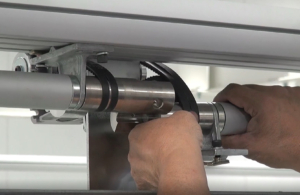 We have replaced belts on regular scheduled maintenance and have only had one time since 2015 when we had a belt completely fail and come apart. As the system is designed, however, we were able to cut the belt free and continue running on three belts.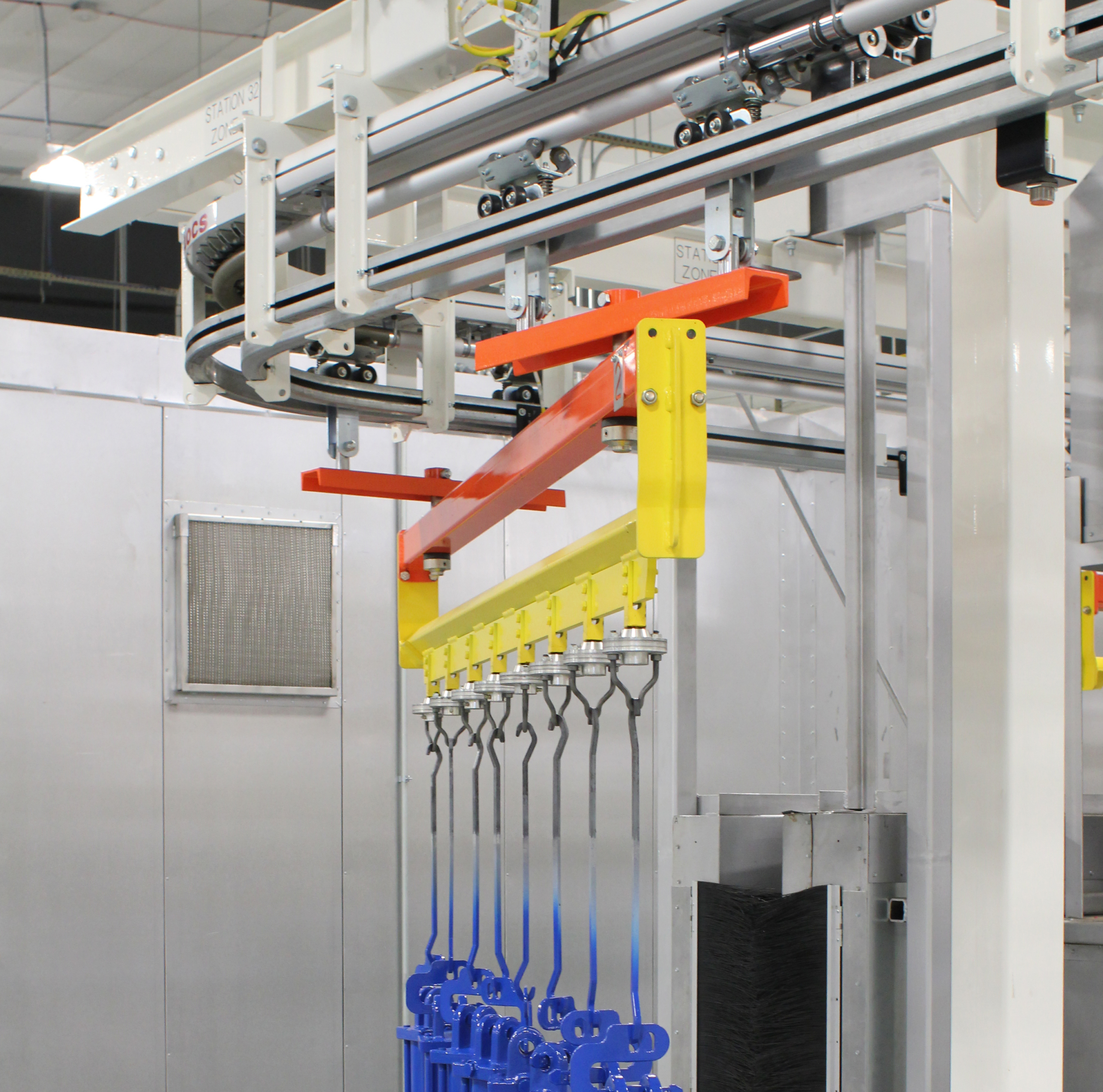
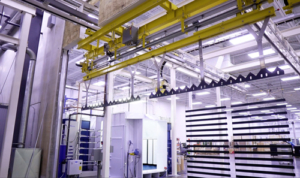 The MRI system features a 20-foot carrier and shuttle on the left-hand side of the system for transporting products from the load area, through an automatic and integrated sliding door into their unheated and uncooled added manufacturing space where automatic washing, dry-off and curing processes occur.
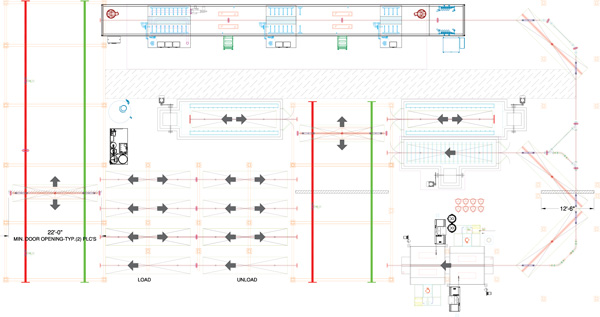 Not all of MRI’s parts require finishing. They also use the system to just wash and dry metal parts that will be unfinished in the final assembled monitors. This greatly improves the overall quality of their sets by removing unwanted dust and oils – a process they used to do by hand.
 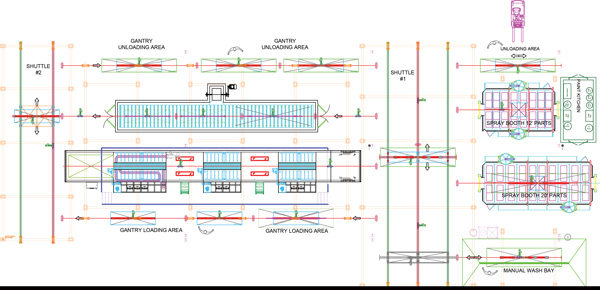 Depending on the size of the part, there are different flow paths through the system. This is caused because one of the two shuttles allows part only up to about half the size of the other shuttle. Since the majority of their parts are at or below 12-ft. in length, after being loaded in the loading lane, carriers proceed to the left onto a shuttle sized for up to 12-foot parts. This shuttle moves laterally from the loading lane to line up with the wash booth lane. From there the carrier can back up off the shuttle moving from left to right and go through a multi-stage automated wash booth lane. After wash, carriers flow onto a larger right side of the system shuttle and into one of their two liquid spray booths. After being coated, items back out of their respective booths and onto the larger shuttle again. The shuttle transports the parts laterally again up to the cure oven lane where they leave the shuttle and flow into the final cure oven. At this step, each carrier can have its own oven timing setting to maximize force cure quality, while eliminating chances of under or over curing products. Cure time is controlled by the system recipe selected at load per carrier. After curing, the carriers move once again to the first shuttle and laterally again up to the unload lane for final unload and the consequential return of the carrier via the large secondary shuttle back to the load area lane on the other side of the system.
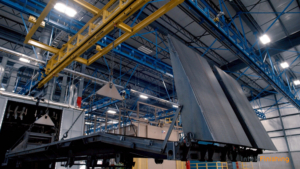 Load Trail had a significant challenge finishing its agricultural trailers. The trailers range in size from 24 to 53 feet in length and weigh up to 10,000 lbs. To help them solve the problem of powder coating these trailers and to streamline their finishing, we installed a
 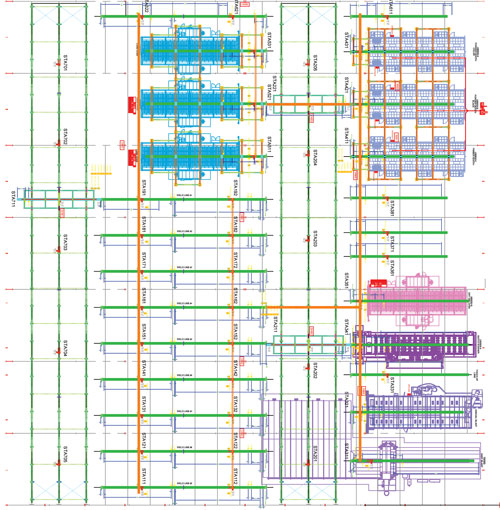 the shuttle, it allows for a massive system, but one that still saves space because it does not require any bulb turns or return sections of chain track.
 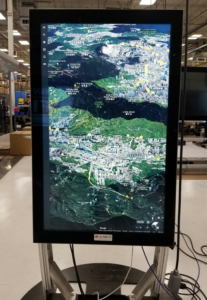 Manufacturing Resources International designs, engineers and fabricates BoldVu® LCD displays, maintaining the industry’s largest install base of outdoor LCDs with deployments in over 50 cities around the globe.
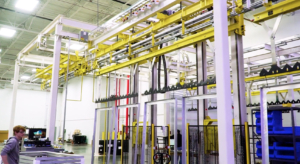 The system can handle parts up to twenty feet long by five feet wide by eight feet tall, and up to 800 pounds per loadbar.
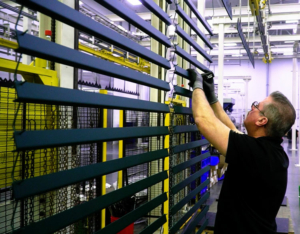 The addition of an IntelliFinishing system has brought a wide range of benefits to MRI’s operation, including:
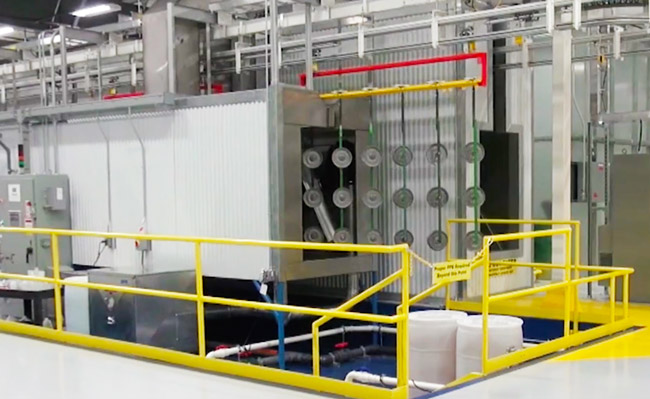 Wash recipes allow for different types of metals or parts with different pretreatment requirements to each have their own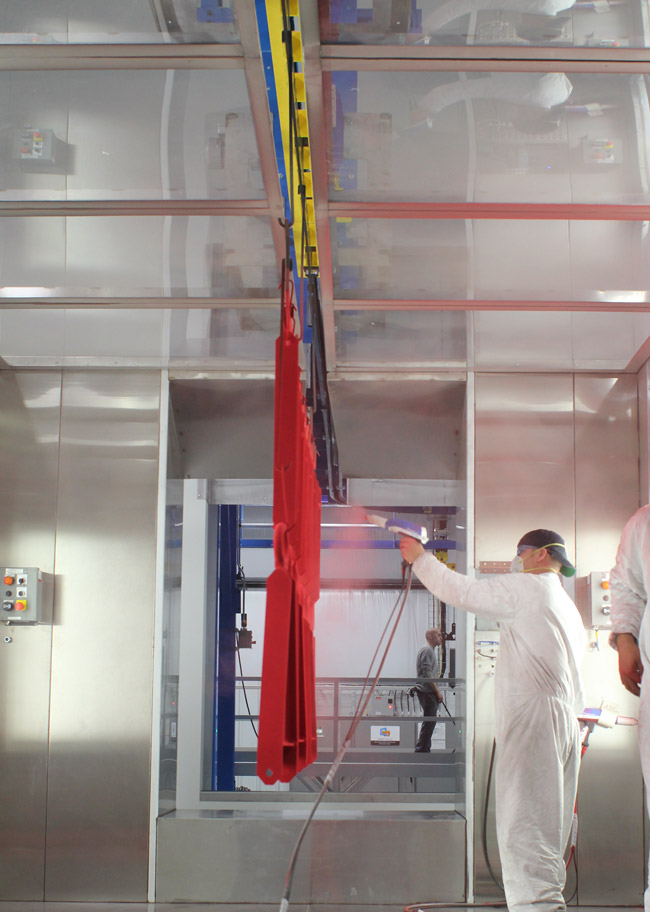
 Imagine your outsourcing of finishing has grown over the years to about $1 million per year with local (or maybe distant) custom-coaters. How much money could an automated, in-house system save you per year that would justify the relatively large capital expenditure?
 Depending on the types of product you need coated, even a relatively traditional monorail could be paid for in about two to four years for this amount of savings. After that, it would be savings that go to your bottom-line profits. Most simple monorail systems likely cost between $500,000 and $2,000,000, but this is entirely dependent on process requirements for pre-finish steps such as shot-blasting, washing, and dry-off ovens, as well as for the type of booths and cure ovens and specific conveyor requirements for the part dimensions and weight considerations.
 Ultimately, this is just a first-cut calculation to begin the process of considering a new finishing system. If your calculus indicates you might benefit from a system, the next step is to start finding a vendor to draft up a layout and determine a budgetary or formal quote.